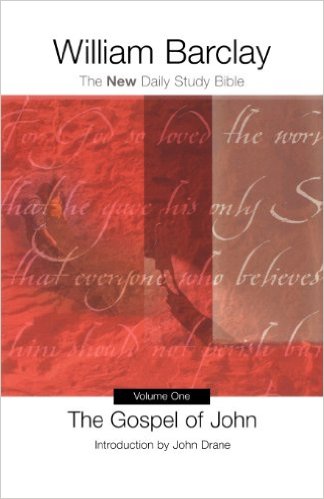
Believing in Jesus, writes Barclay, must mean "at least three things."
"(a) It means believing with all our hearts that God is as Jesus declared him to be...

Musing on MacDonald
Thoughts from Onesimus and guest bloggers
Both MacDonald and Lewis had much to say about God as the ultimate source of joy in our lives. The true child of God, said MacDonald, trusts in the Father, "and looks to him as the source of life, the gladness of being." And of course this was a major theme for Lewis in Surprised by Joy and many other of his writings. So, in the Heavenly Tea and Coffee Shoppe, sometime in the distant future, I'm imagining Lewis and his "master" waving to Piper to pull up a chair and join their conversation. Here's some of what Piper has to say, from the first chapter of Desiring God.
Being a life-long Catholic with some background in Catholic theology as well, along with being a very long time fan of George MacDonald, I was at first dismayed some years ago to discover what I thought to be some anti-Catholic remarks. I do not claim to be an expert in Catholic theology or an expert on George MacDonald. I do claim to ardently follow both and to have been influenced for the best, I hope, by both...
In the New Testament, and especially in the Fourth Gospel, there are four closely interrelated ideas. There is the idea of rebirth; there is the idea of the kingdom of heaven, into which people cannot enter unless they are reborn; there is the idea of being children of God; and there is the idea of eternal life...All these ideas have a common thought behind them...
According to William Raeper, MacDonald believed that “men and women were born out of the heart of God, not Ex Nihilo as traditionally held by the church, and thus MacDonald aligned himself with the Neo-Platonic theories of Plotinus and Origen” (Raeper 1987:243). MacDonald operated under the shadow of Plato; thus not only will MacDonald’s view be explored, but also be compared and contrasted with the neo-platonic doctrines of Plotinus and Origen.